Illustrated parchments in the collection of Baron Louis-Numa de Salis

The Metz municipal archives (France) have once again placed their trust in us, entrusting MEMORIST with a series of vibrantly coloured parchments. These documents originate from the collection of Baron Louis-Numa de Salis, an avid collector of manuscripts and charters. He was born on 27 January 1803 at the Château d’Escafotte and died on 2 October 1880 in the town of Beaumarais. Following his widow’s death, the entire collection was bequeathed to the city of Metz, which aims to showcase this rich heritage. This includes seven parchments dating from the 14th to the 16th century:

  • Letters of nobility and naturalisation confirming the noble status of Pierre Petit and Claude Calot, amongst others, granted by the Duke of Lorraine;
  • A certificate of knighthood issued by Saint Louis;
  • The recognition of Pierre de Bassey’s ennoblement by Charles V.
A technician in protective gear operating a drone and survey equipment inside the historic nave of Notre-Dame Cathedral during post-fire assessments.

Exquisite pieces

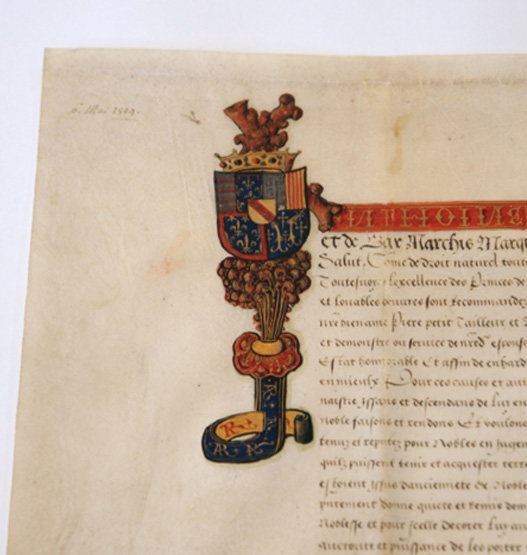
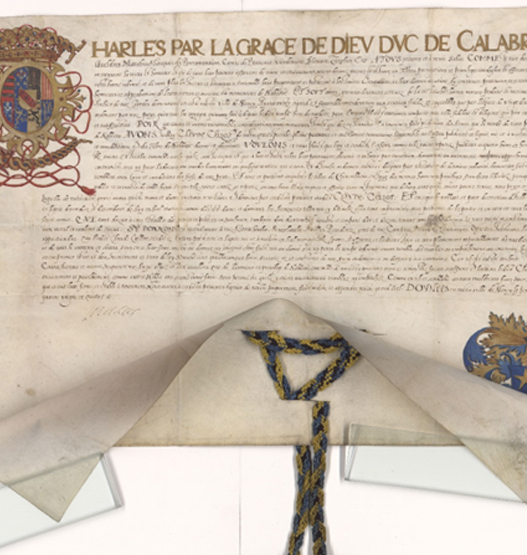
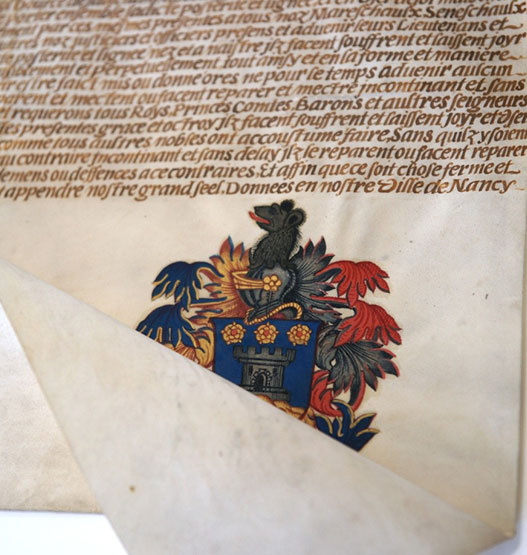
 Ornate drop capital letter decorated with a crown and vivid coats of arms on a historical manuscript page.<br />
These documents are remarkable in several respects. In addition to their great value, they are aesthetically appealing. The drop capitals are meticulously decorated with crowns and vivid coats of arms. The titles are colourful too, both in terms of the text and decorative banners in the background in some cases.
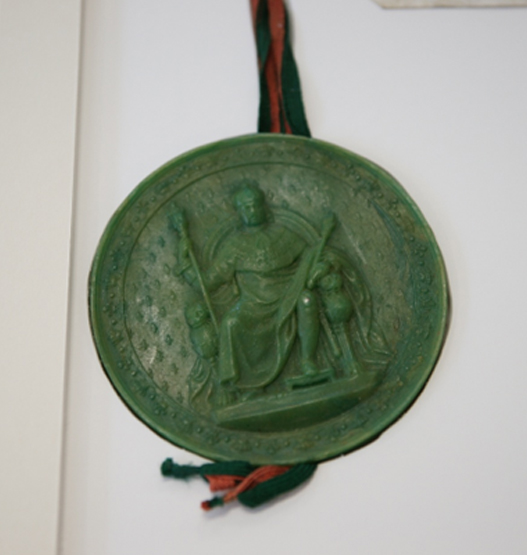
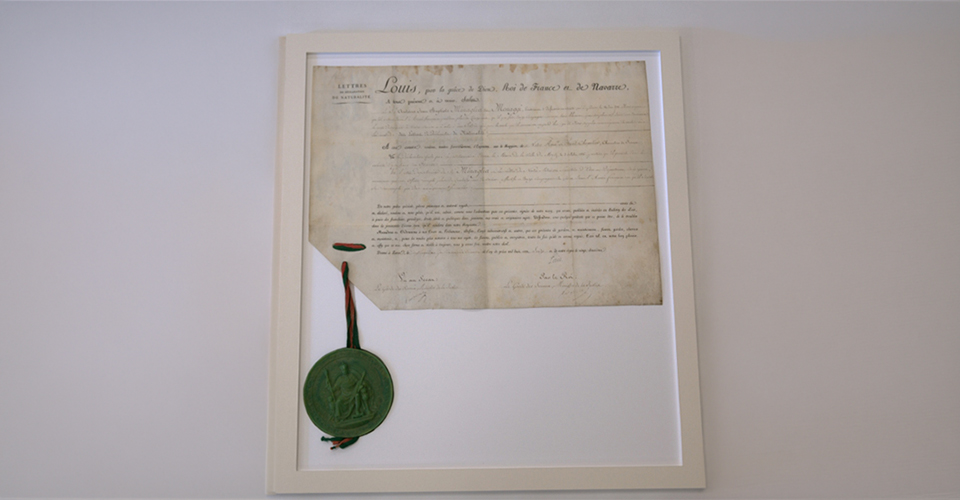
Several documents bear seals made of paper or wax. These seals are green or red. According to sigillography, the study of seals, these colours have specific meanings. For example, a green wax seal on red and green silk cords, as seen here, signifies a document of perpetual validity.
Detailed view of a well-preserved green wax seal suspended by red and green silk cords signifying perpetual validity.
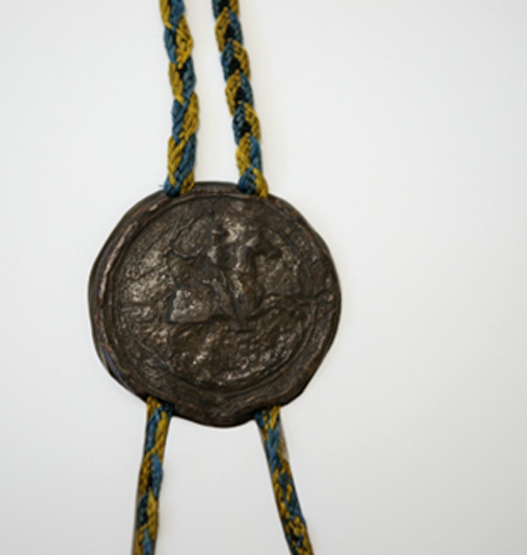
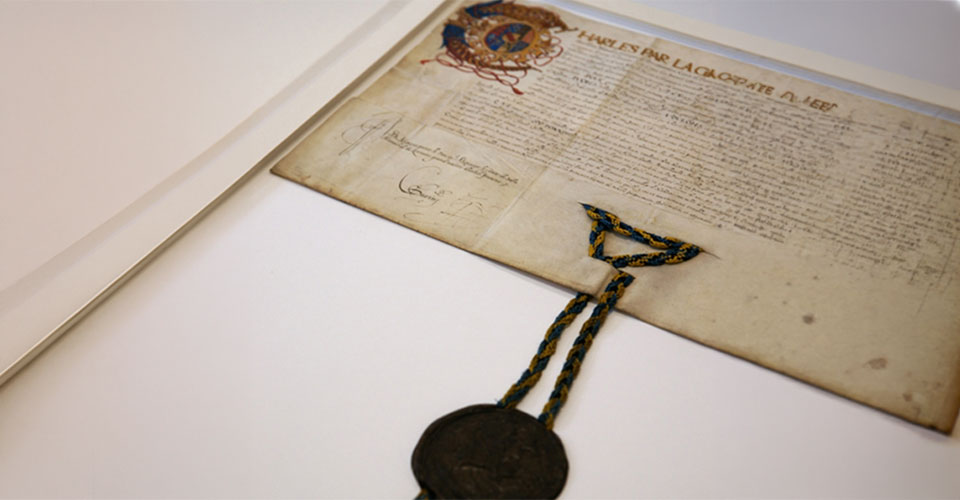
Close-up of a historic pendant seal secured with intricately braided blue and gold silk cords.<br />

These cords are made of various materials that secure pendant seals to documents, known as “pendant seals”. They are distinguished from seals that are affixed directly to parchments. Here, the intricate weaves combine several colours.

In a critical condition
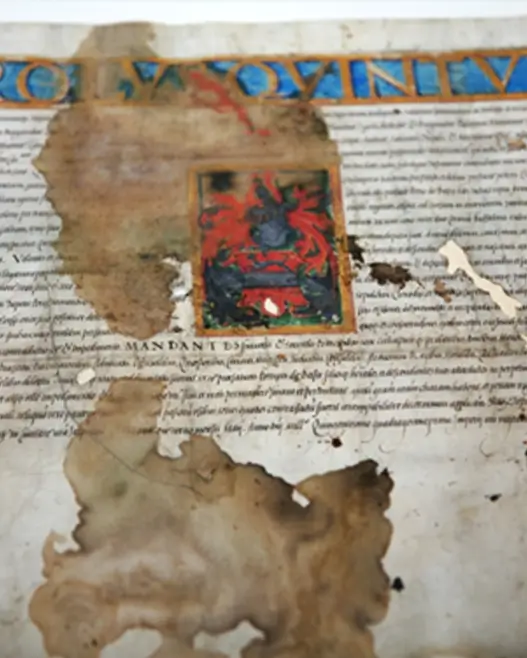
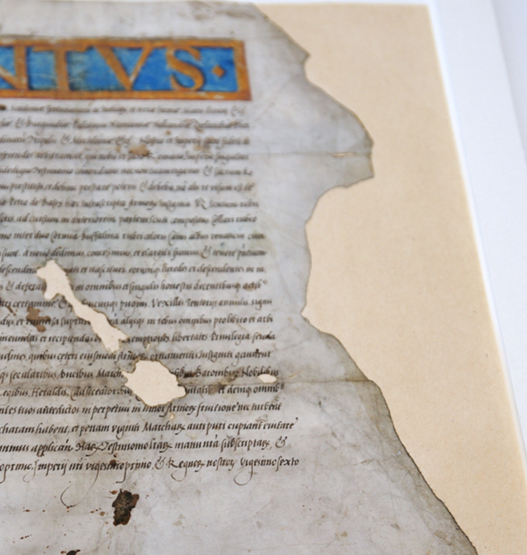
Damaged section of a 16th-century illustrated parchment showing severe stains, discoloration, and text fading
Despite their beauty, the sealed watercolour pieces are in a poor state of repair. Each one shows stains, fading or complete loss of colour in certain areas, as well as tears, gaps and creases caused by unsuitable storage.
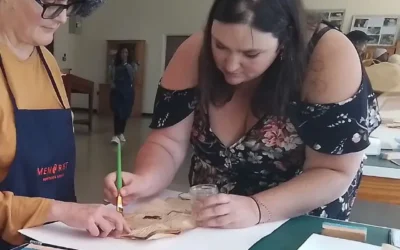
Once each parchment has been analysed and a suitable treatment protocol established for each one, our conservator takes charge of its treatment. First, they meticulously clean the parchments using soft brushes, carrying out selective scrubbing on the most soiled areas provided they are free of ink and not fragile. The parchments are then placed in a humidification chamber to soften them gradually. During this process, moisture is applied to the parchment in a controlled manner to avoid damaging the material and inks. Once sufficiently softened, the parchments are placed between non-woven fabric and blotting paper, which is then lightly weighted down to ensure the parchments lie flat.
Close-up of a fragile, damaged historical parchment before restoration, featuring tears, gaps, and faded ink areas.
Any weakened areas (tears and gaps) are reinforced and filled using neutral Japanese paper of a suitable weight and colour.

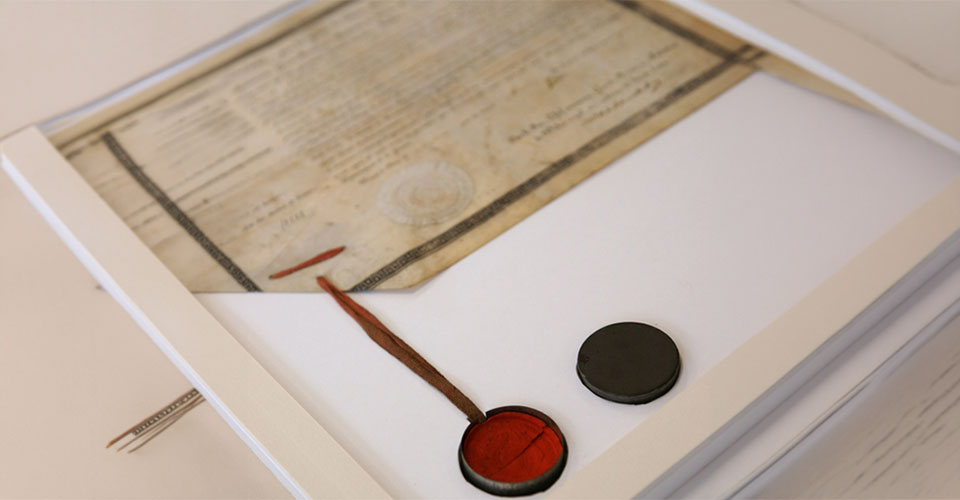
The seals and cords are in better condition than the parchment, allowing for simple cleaning. However, among these sealed items is a seal set in a small tin box. The cord holding the seal and box in place is attached to the bottom of the box and has broken the seal. It is the tension caused by the cord that breaks the wax and would prevent any attempt at repair. Although our workshop is capable of restoring seals, as a precautionary measure, it has been decided not to work on this specific seal once it has been cleaned. Instead, preventive conservation measures have been taken to protect the seal from any future damage thanks to the way it is stored.
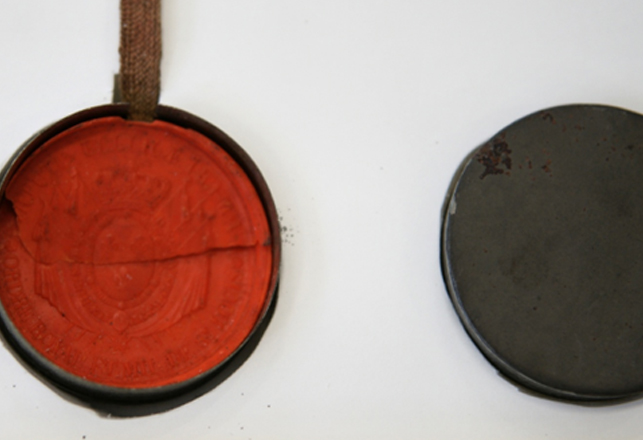
Close-up of a historical red wax seal cracked due to cord tension inside an open tin box storage container.

Bespoke storage…

Close-up of a historic pendant seal secured with intricately braided blue and gold silk cords.
The work of our teams does not stop there. To ensure that the documents survive the test of time, it is essential to store them in the best possible way once they have been scanned. For this purpose, conservation mounts have been created using museum board and foam board. Each parchment is framed by a piece of clear, neutral board and the seals are held in bespoke recessed niches for protection. The mount is finished with a neutral polyester sleeve, allowing the parchments and seals to be viewed without direct contact – ideal for items intended for display or exhibitions. Finally, the display case also features a lid that is hinged with fine fabric to secure it and ensure the document is stored safely.
Bespoke conservation housing protecting a fragile red wax seal set inside a small tin box alongside a historical document
Individual display cases are essential for the proper preservation of sealed parchments. This mounting technique uses only neutral and stable materials, and therefore fully complies with the Bibliothèque nationale de France’s recommendations set out in its special technical specifications for the conservation and restoration of seals and seal-related items in public archives.
Bespoke museum-grade conservation mount housing an illustrated historical parchment document and its green wax seal.

… and a bespoke scanning process

 Heritage scanning process using glass plates to flatten and reveal a concealed coat of arms tucked behind a parchment fold.
MEMORIST has its own heritage scanning workshop, enabling it to scan your documents at the optimal stage of the restoration process.

In the case of parchments, scanning took place once the restoration work was complete to minimise handling.

Scanning was carried out at 300 DPI using a heritage-grade scanning system. A bespoke colour profile was calculated and applied to ensure perfect colour reproduction. Both the front and back of the parchments were scanned, and the seals were photographed separately. Various adjustments to the exposure settings were required to capture their colours and details.

One final detail that had to be highlighted during the scanning process was that one of the parchments featured a coat of arms concealed behind a fold. To reveal it whilst protecting the parchment, a photograph needed to be taken using glass plates.

MEMORIST is at your disposal for any restoration, scanning or storage projects involving sealed parchment documents.

To find out more about our expertise and projects, click here.
To discuss a project with us, click here.
Join our MEMORIST family by signing up to our quarterly newsletter.

    These other articles might be interesting for you
    Notre-Dame 3D Scanning & Post-Fire Reconstruction

    Notre-Dame 3D Scanning & Post-Fire Reconstruction

    Notre-Dame 3D Scanning & Post-Fire ReconstructionEmergency 3D scanning operationFIRST STAGE OF THE RECONSTRUCTIONFollowing the 2019 fires, the MEMORIST team, in collaboration with the company FARO, carried out an emergency operation to...

    Mont-Saint-Michel 3D Survey & Heritage Reconstruction

    Mont-Saint-Michel 3D Survey & Heritage Reconstruction

    3D survey of the Mont saint-Michel Abbey and Merveille buildingA COMPREHENSIVE ASSESSMENT TO PRESERVE AND RESTOREThe prestigious Mont-Saint-Michel complex is highly vulnerable to the elements, which makes its conservation of the utmost importance....

    Exploring Étampes: MEMORIST’s New Augmented Reality Heritage App

    Exploring Étampes: MEMORIST’s New Augmented Reality Heritage App

    The Communauté d’Agglomération de l’Étampois Sud-Essonne intercommunal structure in France wanted to develop a mobile app for cultural outreach aimed at the public. The project is part of a drive to enhance the local area’s appeal by making its...

    This site is registered on wpml.org as a development site. Switch to a production site key to remove this banner.